Complete Guide to ® Lifeguard Certification

The ® Lifeguard Certification: A Comprehensive Guide

The Lifeguard certification is the industry standard for professional water safety. This certification provides the essential knowledge and hands-on skills required to prevent, recognize, and respond to aquatic emergencies. In New York State, this credential is the primary prerequisite for employment at community pools, summer camps, and state-regulated waterfronts.

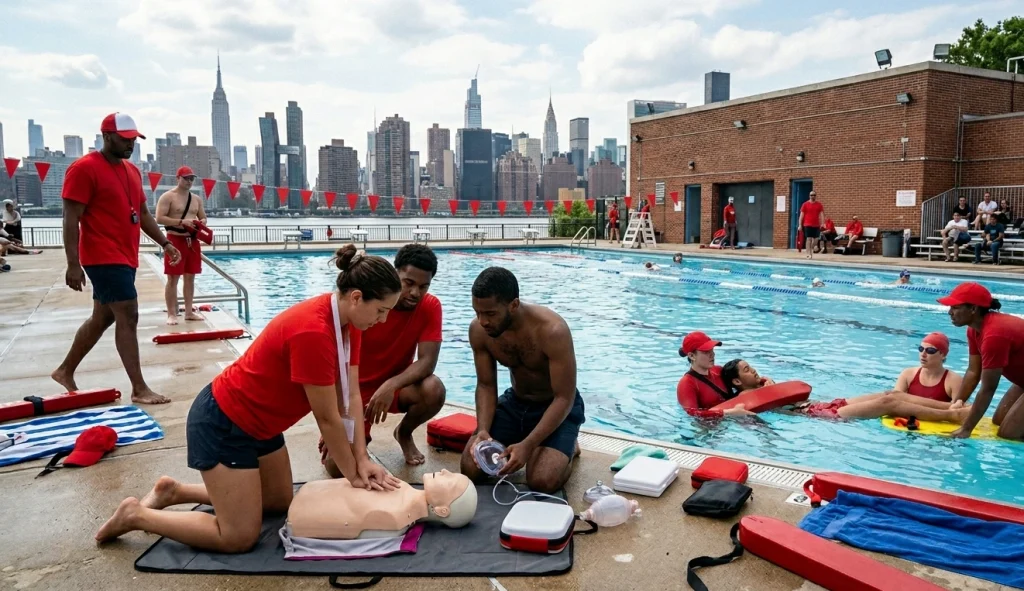
Lifeguard Certification candidates practicing water rescue and CPR skills in New York.

Core Components of the Course

A standard Lifeguarding course is designed to train participants in several life-saving disciplines simultaneously:
Lifeguarding Skills

Surveillance, scanning, and water rescue techniques.

CPR/AED for Professional Rescuers

Advanced resuscitation for adults, children, and infants.

First Aid

Immediate care for sudden illnesses and injuries.

Oxygen Administration

(Optional) Skills for clinical emergency care.

Mandatory Course Prerequisites

Before beginning a certification program, candidates must pass a physical “Pre-Test” to ensure they possess the necessary swimming proficiency.

Before beginning a certification program, candidates must pass a physical “Pre-Test” to ensure they possess the necessary swimming proficiency.

Participants must tread water for two minutes using only their legs. Hands must be placed under the armpits to ensure no upper-body assistance is used.

Before beginning a certification program, candidates must pass a physical “Pre-Test” to ensure they possess the necessary swimming proficiency.

5 Essential Skills You’ll Master in a Lifeguard Course

While swimming is a major part of the role, the ® curriculum focuses on five core pillars of aquatic safety:

Understanding New York Certification Grades

In regions like Nassau County, passing the course is only the first step (Step 1). To work at public facilities, guards must then challenge the County exams based on the environment they wish to guard:
Grade Environment Key Performance Requirement
Grade I Pools 50-yard freestyle in < 35 seconds; 200-yard endurance swim in < 3:45.
Grade II Bays/Lakes 50-yard run-to-swim entry; 100-yard victim carry; Surfboard rescue.
Grade III Ocean 400-yard freestyle with rescue equipment; Single-man ocean rescue.

Training Formats: Traditional vs. Blended Learning

The offers two primary ways to complete the course:
In-Person Training:

All 25+ hours of instruction are conducted at a pool and classroom facility.

Blended Learning:

This modern format consists of a 7.5-hour online simulation and interactive course followed by roughly 19 hours of in-person skills practice. This is often preferred for its flexibility.
What to Expect During Training

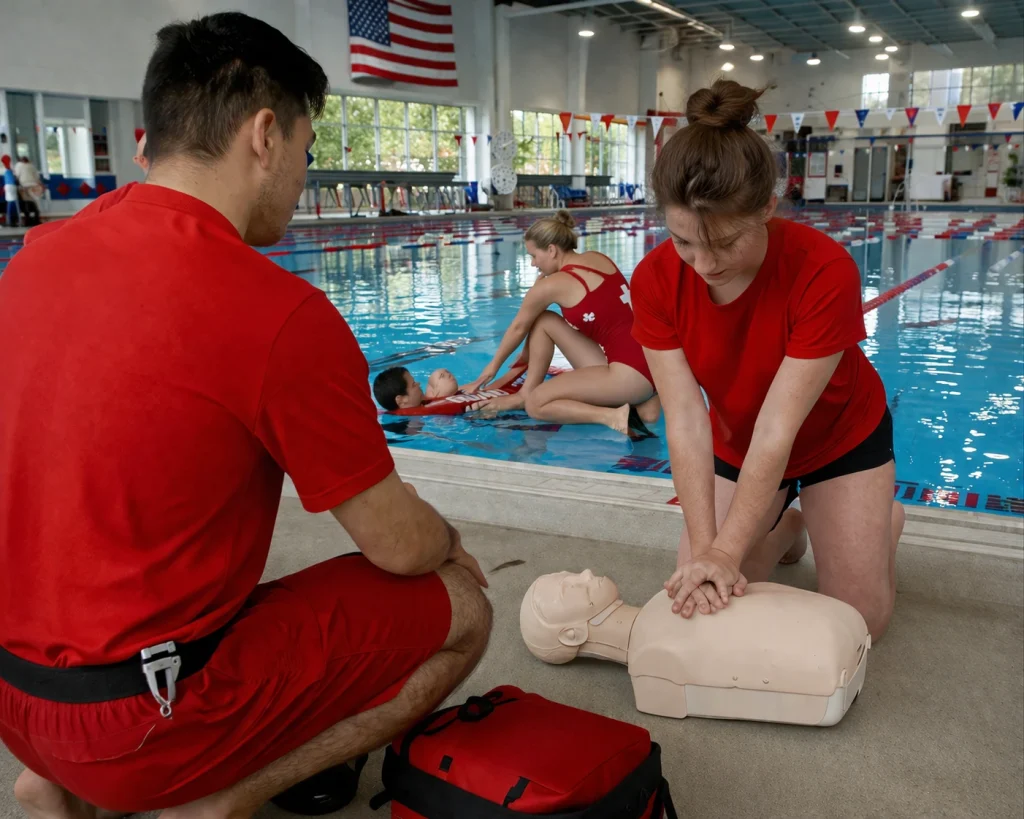
The course concludes with two final assessments. Candidates must score at least 80% on the written exams and receive a “Pass” on the physical rescue scenarios, which include:

Resources for Candidates

To prepare for the course, it is highly recommended that students review the official training materials in advance.

This is a critical update. In 2026, the released the r.26 curriculum, which significantly changed the prerequisites and rescue terminology.

Adding these details will not only help you outrank the 2019 content but will also prevent students from practicing the “old” standards.

2026 Program Updates: What’s New in r.26?

The recently modernized its Lifeguarding curriculum (r.26). Our resources reflect these latest standards, which differ from the older 2017/2019 versions still found on many websites.

Key changes include:

The Lifeguard Certification
Frequently Asked Questions (FAQ)
How long does the ® Lifeguard certification last?
The certification is valid for two years. It includes Lifeguarding, First Aid, and CPR/AED for Professional Rescuers. To maintain your status, you must take a “Review” (recertification) course before your current certificate expires.
The requires participants to be at least 15 years old by the last day of the course. However, individual facilities or New York State parks may have higher minimum hiring ages (often 16 or 18).
No. The 300-yard swim is not a race. You must demonstrate a continuous swim using front crawl or breaststroke with rhythmic breathing, but there is no specific time limit as long as you do not stop or rest.
The “Timed Event” (brick test) is a mandatory prerequisite. If a candidate cannot complete the event within the 1 minute and 40-second limit, they typically cannot continue with the full course. It is highly recommended to practice this skill at a local pool before the first day of training.

A standard Lifeguarding certificate covers Pools and Waterparks. To work at an ocean beach, you must complete additional Waterfront or Ocean Lifeguarding modules, which include specialized training for surf and open-water conditions.

No. All prerequisite swimming must be done without the use of goggles (for the brick test), fins, life jackets, or any other swimming aids.
Yes. Under the r.26 curriculum, the prerequisite swimming distances have been updated for different certification tracks. For a standard Lifeguarding certificate, the requirement is now a 150-yard swim, followed by a 2-minute tread, and finishing with a 50-yard swim. However, the Waterfront track still requires a 350-yard / 2-minute tread / 200-yard sequence.
According to the 2025 standards, goggles are only permitted during the initial swim-tread-swim sequence. They are strictly prohibited during the timed brick retrieval and all subsequent in-water rescue skills.

Yes. The Timed Event remains a core requirement: Swim 20 yards, surface dive to 7–10 feet, retrieve a 10lb object, return on your back using only your legs, and exit the water without assistance, all within 1 minute and 40 seconds.

Previously known as the Primary Assessment, the 2026 Rapid Assessment is a streamlined process for checking responsiveness, breathing, and pulse simultaneously to ensure life-saving care begins within seconds of an emergency.

Frequently asked questions about Lifeguard certification

What does Lifeguard certification involve?

Certification, a prerequisite swim evaluation, and for county and municipal roles a separate qualifying test. Certification alone is rarely the whole requirement.

What does Lifeguard certification cost?

Full lifeguard certification is $420 for one day, recertification $265, and CPR with First Aid $125. County exam fees are charged separately by the county.

How long does Lifeguard certification take?

The certification itself runs a single long day. Building the swim fitness beforehand is what takes most people longer.

Last updated: