Call anytime

Call anytime
Write email
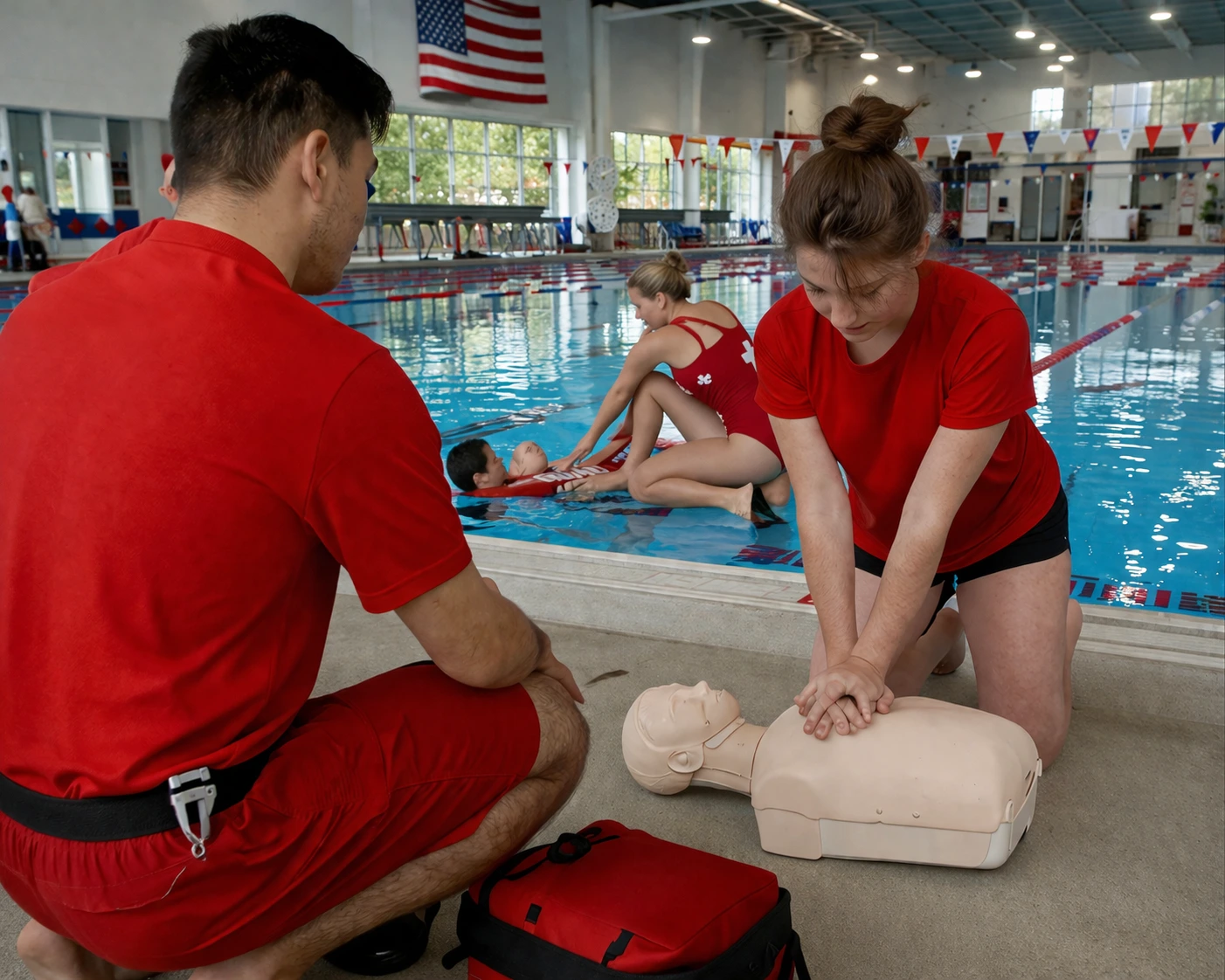
Most people who fail to become a lifeguard in New York do not fail the course. They fail the prerequisite swim test in the first hour of day one, and go home. This page is about that hour, and about what the rest of the day actually looks like, because the sequence is rarely explained before people book.
Before any instruction happens, you have to pass a swim evaluation. It is not a formality and it is not graded generously:
If any of the three fails, the day ends there. Train the tread and the brick specifically, in a pool, before you book.
You can certify at 15, but most New York employers hire at 16, and county positions often require 16. That gap is useful rather than wasted: certify at 15, spend a season building hours where you can, and arrive at the 16-year-old hiring round already holding a current card while everyone else is still trying to book a course.
Certification is $420 for the single full day, 10:00 AM to 8:30 PM, covering lifeguarding with First Aid and CPR/AED. The card is valid two years. Renewal is $265 and takes one day, but only while the certificate is unexpired. Let it lapse and you pay the full $420 again.
Comfortable rather than athletic. The swim distances are short. What defeats people is treading without hands and retrieving weight from the bottom, both of which are technique and practice rather than fitness.
Not yet. The surface dive and brick retrieval are non-negotiable. It is a learnable skill, and a few sessions in a deep pool usually solves it.
Swimwear you have already trained in, goggles that fit, a towel, food for a long day, and photo identification. The day runs over ten hours.
The written section is the least common failure point by a wide margin. Retesting policy depends on the session, so ask on the day rather than assuming.
See lifeguard certification for dates, or lifeguard jobs and careers for what the work pays.
Certification, a prerequisite swim evaluation, and for county and municipal roles a separate qualifying test. Certification alone is rarely the whole requirement.
Full lifeguard certification is $420 for one day, recertification $265, and CPR with First Aid $125. County exam fees are charged separately by the county.
The certification itself runs a single long day. Building the swim fitness beforehand is what takes most people longer.
Last updated: