Call anytime
Call anytime
Write email
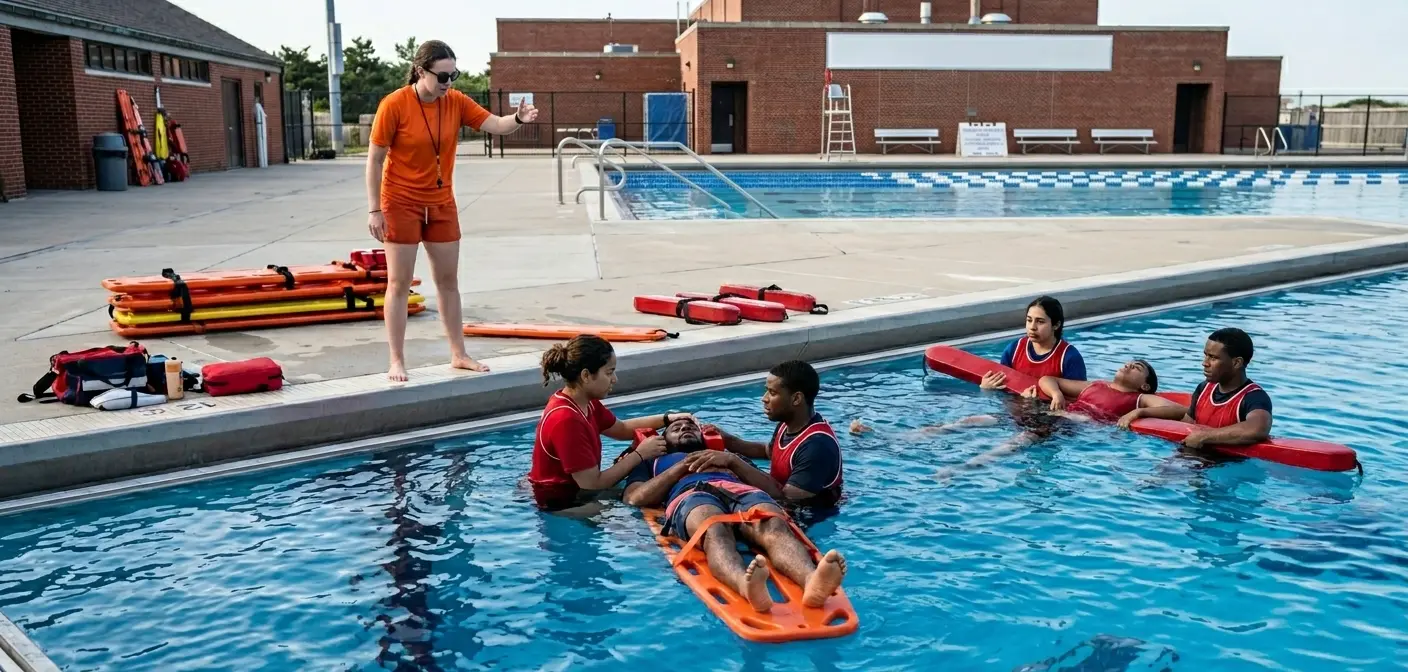
People look for a Water Safety Instructor class in Nassau County because they want the work, not the certificate. This page is about the money: what instructors earn here, where the paid hours actually come from, and how the numbers compare with guarding. Entry requirements are covered at the end.
Teaching pays materially better than guarding. Instructors in New York typically earn $30 to $40 per hour, against $20 to $25 for a guard chair. That gap is the entire argument for the credential, and it compounds because instruction hours are easier to hold onto through the winter.
Demand concentrates in four predictable places: municipal and community pools running learn-to-swim programs, swim schools with waiting lists, summer camps, and private clients wanting one-to-one lessons for a nervous child or an adult beginner. The last of those pays the most per hour and is almost entirely word of mouth, which means the first season is about building a reputation rather than maximising rate.
Courses of this type generally cost in the region of $450. At $30 to $40 an hour, that is recovered within a few weeks of part-time teaching, and the certification then runs two years. The real risk to the return is not the fee, it is certifying without a facility in mind and never teaching at all.
Enrolment terms come from the training provider, and they are broadly consistent.
Certification runs two years and renewal is conditional rather than automatic. You must teach or co-teach at least one eligible course inside that window and complete the online recertification assessment near the end of it. Miss either and the full course has to be retaken, which is the most common way instructors lose a credential they paid for.
On the numbers, yes. The $30 to $40 hourly range against $20 to $25 for guarding recovers the course cost inside a few weeks of part-time teaching.
No. Teaching and guarding are independent credentials and neither requires the other. Holding both is what keeps a schedule full year-round.
Competent across six strokes rather than fast. Nobody times you. What is assessed is whether your technique is clean enough to demonstrate and correct in front of a class.
Yes, and that is where the higher rates sit. Facilities pay a set hourly rate; private clients pay for the instructor rather than the slot.
Lifeguard certification and recertification, CPR with AED and First Aid, swim lessons for children and adults, and lifeguard staffing. See swim instructor certification or lifeguard certification.
Last updated: