Lifeguard Class in Brooklyn

Lifeguard Class in Brooklyn | Expert Rescue Training

Before booking a Lifeguard Class in Brooklyn, it is worth understanding the local market. Brooklyn has a large public pool network alongside the ocean beaches at Coney Island and Brighton Beach, which is why the advice that applies in one part of New York does not transfer cleanly to another. Because there is both pool and open water locally, the qualification you need depends on which one you intend to work.

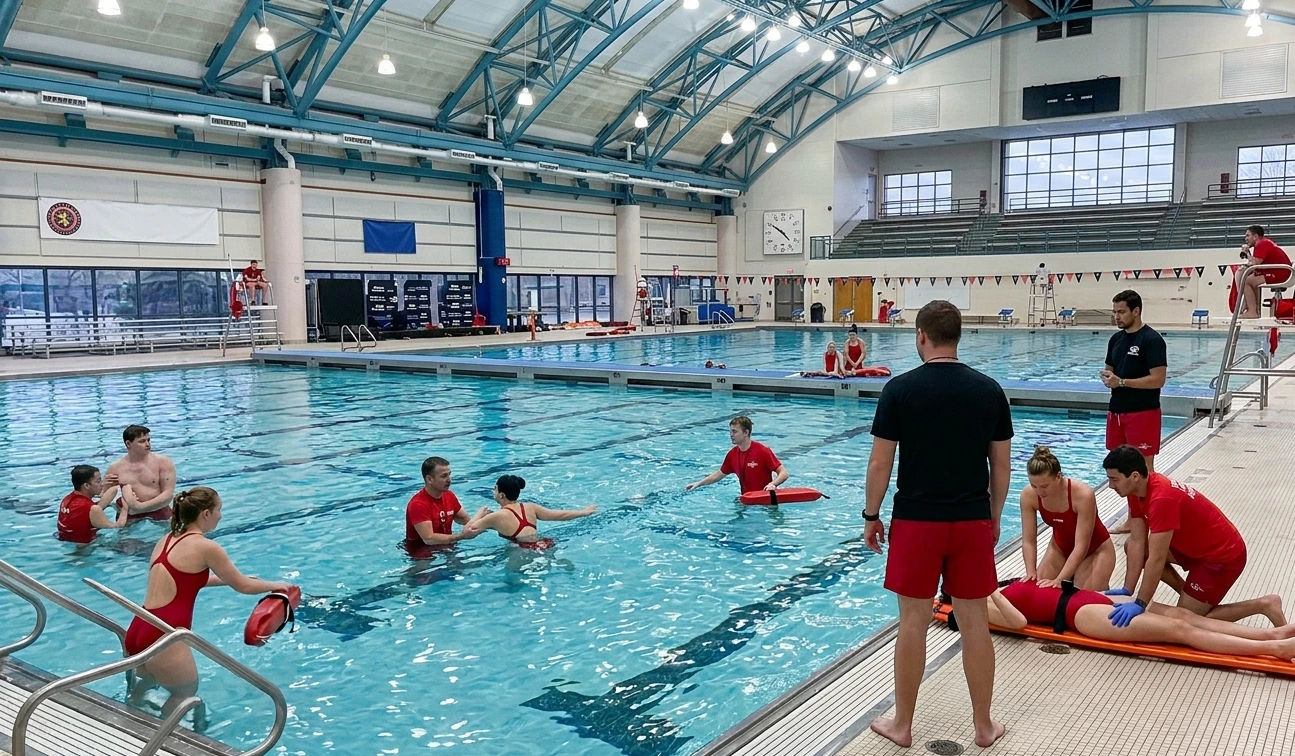
Professional students practicing shallow water rescues during a Lifeguard Class in Brooklyn at a local community aquatic facility.

Lifeguard Class in Brooklyn: the essentials

CoursePriceHours
Lifeguard certification$42010:00 AM to 8:30 PM
Lifeguard recertification$26510:00 AM to 8:30 PM
CPR, AED and First Aid$1252:00 PM to 6:00 PM

Prerequisites you must pass on the day

  • Swim 300 yards continuously
  • Tread water for 2 minutes using legs only
  • Retrieve a 10-pound object from 7 to 10 feet of water and return it within 1 minute 40 seconds
  • Be at least 15 years old for pool certification, or 16 for waterfront

What the course covers

  • Water rescue and spinal injury management
  • CPR/AED for the Professional Rescuer
  • First Aid
  • Surveillance, scanning and zone coverage

Check the facility before you book. Certification is the credential employers ask for, but individual counties and facilities can require their own qualifying exam on top of it, booked and charged separately. Nassau County's exam costs $100. Nassau County is the clearest example, so if you may work there see our Nassau County exam preparation class.

Call (718) 954-5567 or email info@upstateaquatics.com to confirm the next date in Brooklyn.

Why Seek a Lifeguard Class in Brooklyn?

Who actually employs guards in Brooklyn is worth knowing before you certify. The main ones are:

  • school and college aquatic centres
  • YMCAs, JCCs and community centres
  • residential buildings and private clubs with pools
  • city outdoor pools run by NYC Parks
  • the Coney Island and Brighton Beach waterfront

Ocean beach hiring closes early in the spring; indoor pool work runs all year.

Two markets sit side by side in Brooklyn. The pool market is steadier, starts at 15, and runs longer into the year. The waterfront market, at Coney Island and Brighton Beach, facing the Atlantic, is shorter, better paid at some sites, and needs a qualification pool certification does not include. Candidates routinely book the wrong one, discover it at the interview, and lose a season to it.

How Do You Qualify For Enrollment?

Entry to a Lifeguard Class in Brooklyn is decided in the first hour. The evaluation is 300 yards of continuous swimming, a two-minute leg-only tread, and a timed brick retrieval from deep water. It is pass or fail and it happens before instruction.

Furthermore, you will be required to perform a timed weight retrieval. This involves swimming to a depth of roughly 7 to 10 feet, recovering a 10 pound object, and returning to the starting point without using your hands for swimming. From an employer review standpoint, these physical baselines are non negotiable because they prove you have the strength to manage a victim in deep water. If a candidate cannot demonstrate these basics, they will not be permitted to advance to the more complex rescue drills.

What is Covered in the Training Curriculum?

A Lifeguard Class in Brooklyn is taught around vigilance first and intervention second. Zone coverage, scanning patterns and blind spots come before entries and tows, in the order they matter on a real shift.

Key modules include:
For those who are just starting their journey, you can find more details on the Lifeguarding Class. This resource outlines the fundamental steps of the process for new applicants.

Which Training Format is Most Effective?

Two formats are available: everything in one in-person day, or online coursework first followed by an in-person skills day. The choice is about scheduling rather than rigour, since the assessed portion is identical. A Lifeguard Class in Brooklyn follows the same standard in either format.

Feature Hybrid Training Industry Minimums
Skills Verification Mandatory In-Person Varied
Lecture Delivery Online & In-Person Classroom Only
Practical Exam Pass/Fail Skill Test Basic Participation
Professionalism High Authority Basic Entry Level
It is critical to note that if you see a program advertised as online only, it is likely a scam. Most employers do not accept online only certifications because they lack the physical skills verification necessary for safety. Readers must always call their employer or facility to confirm acceptance before paying for a course. If an online program does not list in person training dates, do not sign up.

How Do You Maintain Your Credentials?

After completing a Lifeguard Class in Brooklyn, two years is the validity period. Renewing is straightforward and inexpensive while the certificate is current; once it has properly expired the only route back is the full course, which is the most avoidable cost most guards ever incur.

If your current certificate is nearing its end, you should look into a shortened renewal course. These sessions focus on reviewing core competencies and testing your ability to respond to a submersion event. Many local facilities require annual CPR refreshers even if the full lifeguard license lasts longer, so always stay informed on your specific employer’s policy. You can find more general information on the Lifeguard Certification Course New York .

6 Essential Steps to Certification

1. Verify Eligibility

Ensure you meet the age and physical fitness requirements.

2. Find a Local Class:

Search for a lifeguard class in Brooklyn that offers a schedule fitting your needs.

3. Complete Pre-course Work:

Finish any required online modules or reading assignments.

4. Pass the Swim Test

Demonstrate your endurance and strength in the water on day one.

5. Master the Skills

Participate in all dry land and in water drills, focusing on scanning and rescue entries.

6. Final Testing

Successfully complete the written exam and the practical rescue scenarios.
Legal and Regulatory Standards

The New York City Department of Health and Mental Hygiene oversees pools and bathing facilities in Brooklyn, and its requirements are the reason employers here are inflexible about paperwork. An expired card is treated the same as no card at all, and a facility that lets one slide is the one that fails an inspection.

A Lifeguard Class in Brooklyn spends real time on record keeping, which surprises candidates who expected only rescue skills. The reason is simple: when an incident is examined afterwards, the written record is the evidence. Equipment logs work the same way, and the city health department treats a missing log as a failure whether or not the equipment was in fact fine.

Advanced Rescue Techniques

The technical sequence taught in a Lifeguard Class in Brooklyn is entry, approach, control, tow, and removal from the water. Each step has a pool form and an open-water form. At Coney Island and Brighton Beach, facing the Atlantic the removal is frequently the hardest part rather than the rescue itself, because there is no wall and no ladder, and that is the part candidates have usually never practised.

The skills are practised past the point of competence and into the point of habit, because an emergency compresses decision time to almost nothing. Just as important is what happens on the deck: crowd control, directing help, and a clear handover when emergency services arrive. Facilities across Brooklyn frequently operate with two or three staff, and a rescue that goes well is usually one where those roles were assigned before it started.

Lifeguard Class in Brooklyn | Expert Safety Training
FAQs – Lifeguard Class in Brooklyn
Where can I find a Lifeguard Class in Brooklyn?

Look for a provider running in-person skills sessions at a pool you can reach, and check that the program includes a physical testing component, since a certification without one will not be accepted for employment. Availability of a Lifeguard Class in Brooklyn is heaviest through spring, which is also when it is most competitive: ocean beach hiring closes early in the spring; indoor pool work runs all year.

No, a lifeguard class in Brooklyn must include in person training to be valid. Online only programs are commonly a scam and most employers do not accept online only certifications. You must participate in a physical skills verification to prove you can perform rescues and CPR effectively in a water environment. A lifeguard class in Brooklyn is only legitimate if an instructor watches you perform the required skills in the water.
Most programs take between 20 and 25 hours to complete. This is usually spread over a few days or multiple weekends. A lifeguard class in Brooklyn involves intensive training, so candidates should be prepared for long days in the water and the classroom to cover all required safety protocols. This time investment ensures that every student is fully prepared for the responsibility of guarding lives.
If you cannot pass the prerequisites on the first day, you generally cannot continue with the course. Instructors recommend that candidates practice their distance swimming and surface dives before the start date. This ensures they are physically ready for the demands of the training and the eventual job responsibilities. Being prepared before you start a lifeguard class in Brooklyn is the best way to ensure success.

The bar is confidence rather than athleticism. The prerequisite evaluation asks for 300 yards continuous, two minutes treading water using legs only, and a 10-pound object retrieved from 7 to 10 feet and returned within 1 minute 40 seconds. Practise the tread and the retrieval specifically: they are technique rather than fitness, and they are where candidates for a Lifeguard Class in Brooklyn most often fail.

Yes, every legitimate program includes professional level CPR, AED use, and first aid. This training prepares you to handle breathing emergencies, cardiac arrest, and sudden illnesses like heat stroke or seizures. These skills are tested both through a written exam and through hands on practical demonstrations during the class. You will learn how these medical skills integrate with water rescue during your lifeguard class in Brooklyn.
Conclusion

What a Lifeguard Class in Brooklyn actually produces is someone who can be trusted with a zone for a full shift. That is a different skill from swimming well, and it is the one employers in Brooklyn are paying for, given that the local picture is a large public pool network alongside the ocean beaches at Coney Island and Brighton Beach.

Certify before the season rather than during it. Ocean beach hiring closes early in the spring; indoor pool work runs all year. A certificate earned over the winter reaches employers while roles are still open; the same certificate earned in June arrives after most of them are filled.

Frequently asked questions about Lifeguard Class in Brooklyn

How long does the certification last?

Two years. Let it lapse properly and the only route back is the full course at full price.

What happens if I fail the swim test?

You would not continue with the course that day. The evaluation is deliberately first so that nobody spends a full day to fail at the end.

When should I certify for work in Brooklyn?

Winter or early spring is the sensible window. Ocean beach hiring closes early in the spring; indoor pool work runs all year.

What are the prerequisites for Lifeguard Class in Brooklyn?

A swim evaluation at the start of the day, and age 15 by the last session. The evaluation is pass or fail and is where most unsuccessful candidates stop.

Is the course run in person?

The skills and the assessment are always in person. Some providers move lecture content online beforehand, but a course advertised as entirely online does not produce a certification employers accept.

Last updated: